


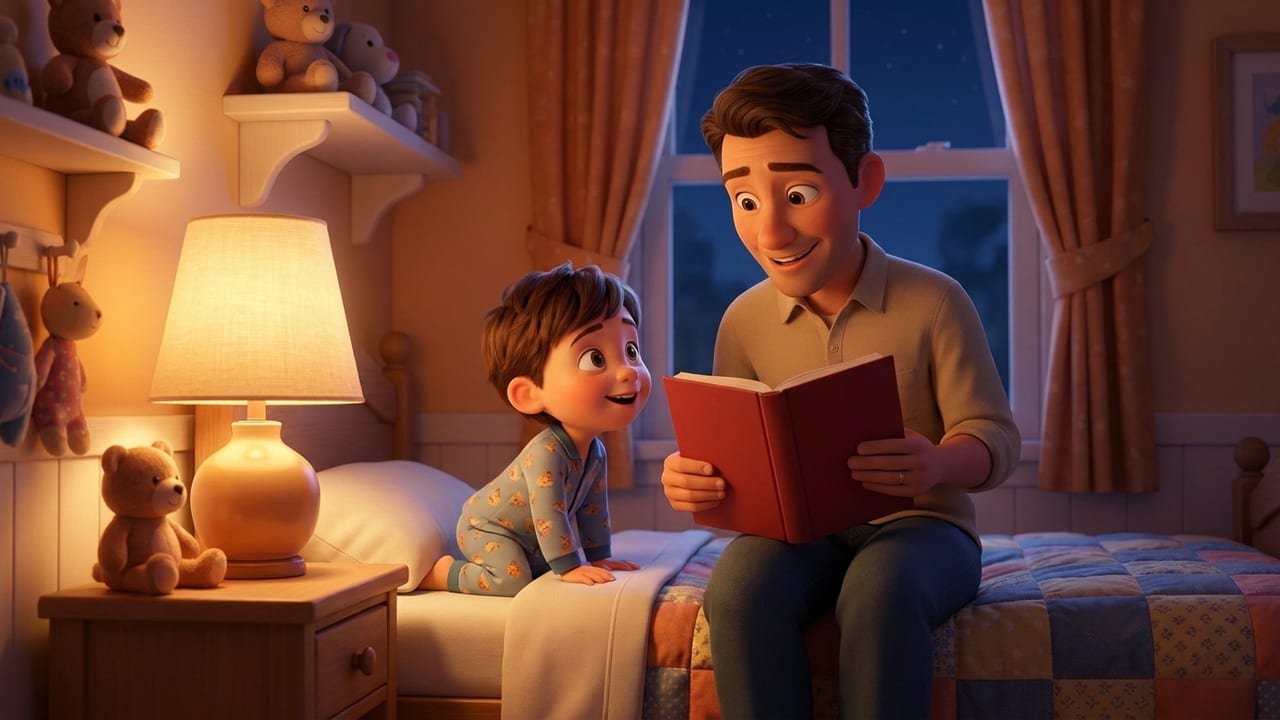
There's a moment that happens in a thousand homes every night. The lights are dimmed. The day is winding down. A child climbs into bed and reaches for the same worn book they've asked for again. "Again?" you ask, even though you already know the answer.
Again.
You read the words for the hundredth time. And somewhere in those familiar pages, something is happening that you can't see—but it's shaping who your child is becoming.
Here's what that moment taught me: the stories we read to our children aren't just entertainment. They're identity formation. They're the scripts our kids use to understand who they are, what they deserve, and how the world works.
Now imagine that moment with one small change. What if your child's name was on every page? What if they weren't just watching a hero—they were the hero?
That's not just a sweet surprise. It's developmental science.
What Research Actually Says About Personalization
Let's start with what we know from decades of child development research.
Attachment theory, first developed by psychologist John Bowlby and expanded by Mary Ainsworth, shows us that children develop a sense of security and identity through their relationships with caregivers—and through the patterns of consistent, reliable love they receive. When a child knows they're genuinely known and valued, they internalize that as part of who they are.
A personalized book does something remarkable within this framework. It says, without words: You are so known that the story was written for you. That matters more than we might think.
Research on self-concept development shows that children begin forming their understanding of "who I am" around ages 3-4, and this accelerates significantly between ages 5-8. During these critical years, children are actively comparing themselves to others, absorbing the messages around them, and building the internal narrative they'll carry into adulthood.
When a child sees themselves as the main character in a book—not an afterthought, not a generic "child" in the illustrations, but the protagonist—it reinforces something profound: I belong in this story. I matter to this story.
This isn't speculation. A 2019 study published in the Journal of Research in Childhood Education found that children who engaged with personalized storybooks showed significantly higher levels of reading engagement and comprehension compared to those reading non-personalized versions. When children see themselves in the story, they pay closer attention. They read longer. They remember more.
That's not surprising when you think about it. Grown-ups do the same thing. When you read a novel and the main character shares your name, your profession, your hometown—don't you lean in a little more? Don't you feel seen?
Kids are no different. They're just more honest about it.
The Science of Being the Hero
There's a field of psychology called narrative identity, pioneered by researchers like Dan McAdams, that studies how the stories we tell about ourselves shape who we become. The conclusion is striking: the narratives we internalize about our own lives—the stories we tell ourselves about who we are—directly influence our goals, our choices, and our sense of well-being.
Children are natural narrative constructors. They play make-believe. They create elaborate imaginary worlds. They see themselves as heroes in their own daily dramas. When we give them books that reinforce this—when we put them inside the story as the main character—we're not just making reading more fun. We're helping them practice being the hero.
Think about what happens when your child is the brave one who helps the lost animal find its way home. When your child is the one who shows kindness to a scared friend. When your child is the one who solves the problem, not because they're perfect, but because they tried.
They're not just hearing a story. They're rehearsing who they can become.
This connects to what developmental psychologists call "possible selves"—the envisioned futures that motivate current behavior. When children see themselves as capable, kind, brave, and loved in stories, they're more likely to envision themselves as capable, kind, brave, and loved in real life.
Personalized books make this rehearsal more powerful. The gap between "the hero" and "me" collapses. There's no distance. There's no "I wish I were that kid." There's just: I am that kid. I already am.
Why the Message Matters as Much as the Method
Here's where things get deeper—and where I've seen personalized books truly change families.
Personalization is powerful. But not all personalized books are created equal. Some will put your child's name in a generic story about being good, trying hard, or earning love through behavior. The message is still conditional. The underlying story is still: You are loved when you perform.
That's not what we're after.
What matters is what the story says about your child—not just that it says your child's name. A book that personalization your child's name into a story about earning approval is still teaching conditional love. A book that personalization your child into a story about being valued simply for who they are—that's different.
That's the kind of book that helps a tired mom at bedtime speak something true over her child.
The research on conditional love and child development is clear: children who grow up receiving love primarily based on their performance—getting good grades, behaving well, achieving—struggle with anxiety, perfectionism, and a fragile sense of self-worth. Children who receive unconditional love, who are valued not for what they do but for who they are, develop more secure identities and greater resilience.
This is why the "already loved" message matters so much. It's not just a nice sentiment. It's developmental protection. When your child hears at bedtime that they are loved—not because they were good today, not because they tried hard, but simply because they are—that becomes part of their internal narrative. It becomes the story they tell themselves when things go wrong.
A personalized book that carries this message does something no regular book can: it makes the child the recipient of unconditional love inside the story, not just a witness to it.
That's the difference between a novelty and a transformation.
How to Choose the Right Personalized Book
If you're sold on the idea (and I hope you are), here's how to choose a personalized book that actually delivers:
1. Look at the message, not just the personalization. Does the story reinforce that your child is loved unconditionally? Or does it slip into "be good and good things happen" territory? Read the full text before you buy. The story matters more than the customization feature.
2. Check the quality of the writing. Some personalized books feel like Mad Libs—your child's name awkwardly stuffed into a weak plot. Others feel like real, compelling stories where the personalization enhances the narrative. Look for books with actual craft.
3. Consider the illustrations. Children read pictures before they read words. Do the illustrations feel warm and inviting? Do they reflect diverse families and experiences? Will your child want to look at these images again and again?
4. Think about what your child needs to hear. Some children need to hear they're brave. Others need to hear they're kind. Others need to hear they are enough exactly as they are. Choose a book whose message meets your child where they are.
5. Make it a ritual. A personalized book is most powerful when it's part of your regular reading routine. The repetition compounds. The message lands deeper. Choose a book you'll both enjoy reading a hundred times.
At AlreadyLoved, we created our Personal Edition books specifically for this purpose: to give tired parents a tool that does the heavy lifting at bedtime. Every story puts your child as the main character. Every message is rooted in unconditional love. We didn't just want to personalize the name—we wanted to personalize the truth.
The Bedtime You're Already Doing, Made Deeper
Here's what I want you to know: you're already doing this. You're already reading to your child at bedtime. You're already showing up, night after night, to speak love over them. That matters more than any book.
But if you're looking for a way to make those moments go deeper—for your child to see themselves clearly in the story, for the message to land in a new way, for the ritual to carry even more weight—a personalized book might be exactly what you're looking for.
Not as a replacement for your presence. As an enhancement of it.
So tonight, when your child asks for "the one with my name," you'll know what you're actually doing. You're not just reading a story. You're building an identity. You're rehearsing a truth. You're helping your child see themselves as the hero they've always been.
And maybe, somewhere in the back of their mind, they'll carry this with them: I am the kind of person this story is about. I already am.
Create your child's Personal Edition today at Start your child's book—because your child deserves to see themselves as the hero of a story rooted in unconditional love.