


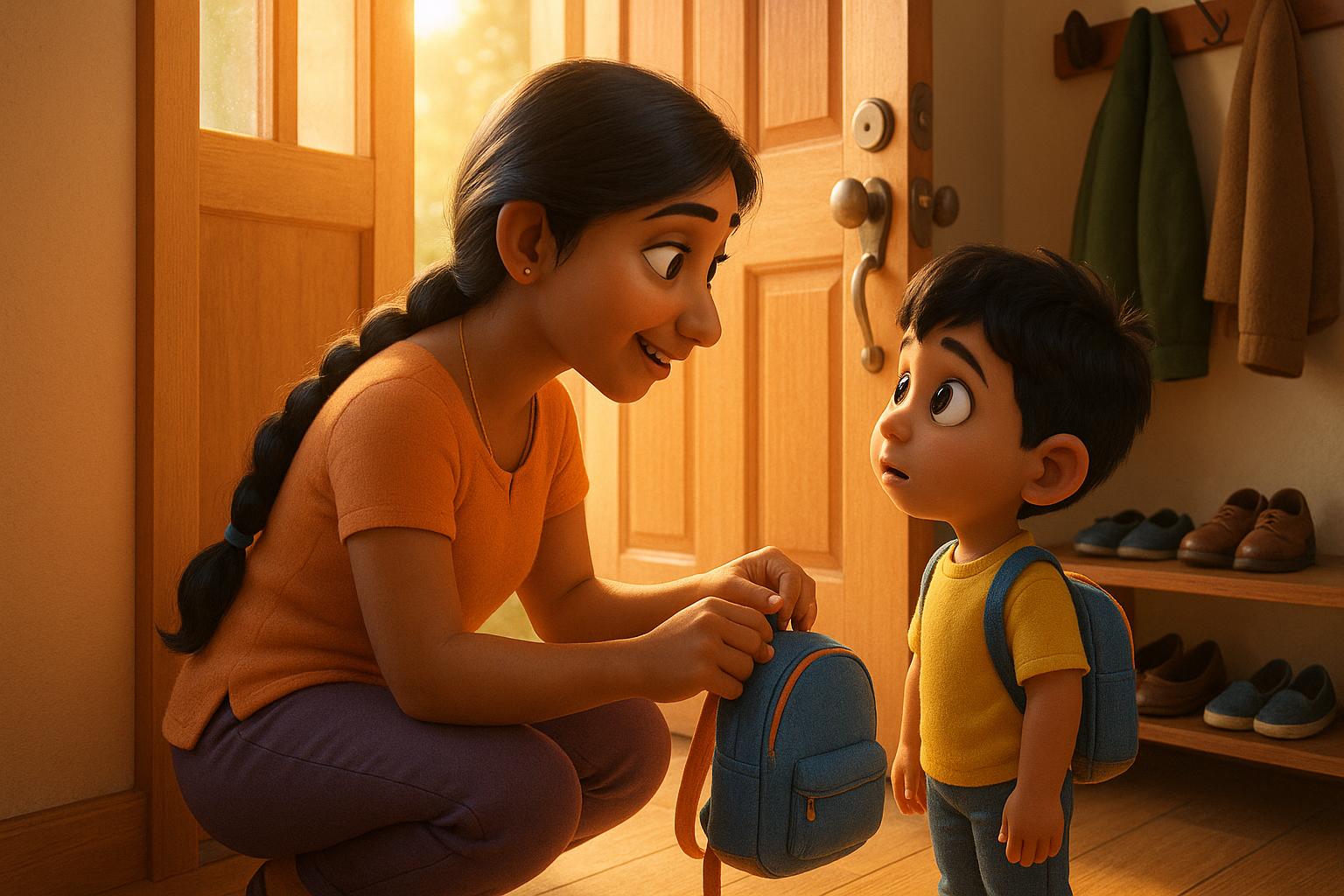
You're dropping your four-year-old at preschool. She clings to your leg. You gently peel her off, look into her eyes, and hear yourself say: "Be good today, okay? I love you."
Then you feel it. That small twist in your stomach. Because somewhere between the car door closing and the classroom door opening, you know: that wasn't the right thing to say.
You're not a bad parent for saying it. "Be good" just slips out. It's what we heard as kids. It's what we defaulted to when we're rushed, tired, or worried about our child's behavior. It feels like the right motivator.
But here's what neuroscience tells us: "Be good" is actually training your child's brain the wrong way.
The Hidden Message in "Be Good"
When you tell your child to "be good," what you think you're saying is: "Make good choices. Be kind. Follow the rules."
What your child is actually hearing is: "Your worth depends on your behavior."
That might sound like an overreaction. But stay with me.
A young child's brain doesn't have the executive function to separate action from identity. They can't think in abstract terms yet. They don't think: "My behavior is one thing; my value is another." Instead, their developing brain consolidates: If I'm good → I'm valuable. If I'm bad → I'm not.
Every time you tie your love, approval, or acceptance to their behavior, you're building a neural pathway that says: Love is something I earn. I am good when I perform well. My belonging depends on my output.
This becomes their internal belief system. By age six, when this identity is largely formed, your child has already learned: "I am the sum of my successes and failures."
What Happens When "Be Good" Kids Face Reality
Fast forward to middle school. Your daughter tries out for soccer. She doesn't make the team. Your son attempts the science fair. His experiment doesn't place. A kid who was raised on "be good" suddenly faces the truth: He's not good enough.
And this is where conditional approval creates a subtle crisis.
The "be good" child has learned that their value is tied to achievement. So when they fail—which all kids do—they don't think: "That didn't work. I'll try again." Instead, they internalize: I'm not good. I'm a failure. I let people down.
We see this play out in adolescents with performance anxiety, perfectionism, and fragile self-esteem. These aren't problems with the child. They're the predictable result of an identity system built on performance.
The irony? Conditional approval doesn't even produce better behavior. Research shows the opposite. Kids raised with conditional love show more anxiety, more behavioral problems, and less intrinsic motivation. They behave well when someone's watching. They fall apart when no one is.
But kids raised with secure identity—who know they belong unconditionally—actually choose better behavior. Not because they're afraid of losing love, but because they're operating from a place of security.
What God Actually Says
Here's where theology becomes practical.
God doesn't say to us: "Be good, and I'll love you."
He says: "You are mine. I delight in you. I loved you before you took your first breath. That love is not contingent on your performance."
This is the gospel in a nutshell: We are loved not because of what we do, but because of whose we are.
When you're raising your child, you're teaching them—through your voice and actions—what love looks like. You're answering the question they ask with their whole being: Am I safe here? Am I acceptable? Do I belong?
If your answer (whether you mean to send it or not) is "only if you're good," you're teaching them a false gospel. You're training their heart to believe in a love that's always conditional, always in question, always something to earn.
But if your answer is "yes, absolutely, no matter what," you're teaching them the real gospel. You're showing them what it looks like to be loved unconditionally.
What to Say Instead
So what do you say when your child is about to walk into a situation where their behavior matters?
Instead of: "Be good."
Try one of these:
"Remember who you are." This is powerful because it shifts the focus from external behavior to internal identity. You're saying: You belong to this family. You're kind. You're brave. You're creative. Now go show them who you are.
"I love you. Go have fun." Short, secure, unconditional. Your child walks into that classroom knowing that your love isn't on the line based on today's performance.
"You belong here, and you're going to do great things." This combines belonging with possibility. You're not saying "be perfect." You're saying "I believe in you, and you're already loved here."
"I love watching you try." Use this when they're facing something challenging. This tells them that you value effort, not just outcomes. That trying is already winning.
"God made you so good. Go be you." For the faith-filled family, this anchors them to their deepest identity—created, loved, and already complete in Christ. Their behavior isn't creating who they are. It's expressing who they already are.
"I'm so glad you're my kid." Maybe the simplest, most powerful message. Not "I'm proud of you" (which ties approval to achievement). But "I'm glad you exist." That's unconditional.
The Parent Who Made the Switch
I want to tell you about a mom named Rachel who realized this wasn't working.
Her daughter Emma was five. Rachel found herself saying "be good" constantly—at drop-off, before playdates, before church, before bedtime. Emma was a sweet kid, but Rachel realized she was anxious. She'd get upset if she made a small mistake. She was scared of disappointing people.
One night, after reading Emma a bedtime story, Rachel said the usual: "Be good at school tomorrow, okay?"
Emma looked up and asked: "Mommy, am I good now?"
Rachel's heart broke. Because Emma was asking the real question underneath: Do you think I'm good? Is my goodness in question?
That night, Rachel made a shift. The next morning at drop-off, instead of "be good," she said: "I love you so much. Have a great day being yourself."
It wasn't magic. Emma didn't transform overnight. But over weeks and months, Rachel noticed something changing. Emma stopped apologizing for small mistakes. She tried new things instead of freezing in fear. She was lighter, freer, more confident.
Why? Because Emma's brain was slowly learning a new message: I'm loved whether I'm perfect or not. My belonging isn't in question. I can just be.
What About Real Behavior Problems?
I can feel the question forming: "But what if I don't say 'be good' and my kid acts out?"
Here's the beautiful truth: Identity-first parenting actually produces better behavior long-term.
When your child knows they're fundamentally loved, they're not operating from fear or anxiety. They're not trying to earn approval. They can actually hear your boundaries because they're not wrapped up in existential fear.
So yes, you still set limits. You still say "that's not okay" when they bite their brother or talk back. But you say it from a place of secure identity:
"I love you so much, AND we don't hit. We use words. You're such a caring person, and your body hit him. Let's help your body make a different choice."
Notice the difference: You're not saying "you're bad." You're saying "you're good, and that specific choice wasn't okay." You're separating the child from the behavior.
This is how children actually change. Not through shame. But through knowing they're safe enough to be honest, fail, and try again.
The Grace Part
Here's what I want you to know: You've probably said "be good" a thousand times. You've probably tied your approval to achievement without meaning to. You've probably used performance-based language with your kids.
That doesn't make you a bad parent. It makes you human. It makes you someone shaped by a culture that taught you the same thing.
But now you know. And knowing changes everything.
You can't go back and un-say the things you've said. But you can start today with a new message. One small interaction at a time. One moment of "I love you anyway" instead of "be good."
Your child's brain is still forming. Identity is still being built. It's not too late. In fact, the next few years—while they still believe you implicitly—are the perfect window to install a different message.
The message that they are already good. Already loved. Already belonging.
Not because of what they do. But because of who they are.
This Week
Pick one moment this week where you'd normally say "be good." It might be drop-off, or a playdate, or bedtime.
And instead, say one of these:
- "Remember who you are."
- "I love you. Go have fun."
- "I'm so glad you're my kid."
Just once. See how it feels. Notice if your child's response is different.
I'm betting it will be.
Because deep down, your child doesn't need to be good. They need to be loved. And when they know they are—unconditionally—the good stuff follows naturally.
That's not wishful thinking. That's neuroscience. That's theology. That's how humans actually work.
The goal of AlreadyLoved is to give you tools for the moments when you don't know what to say. Our personalized books are one small tool—a bedtime anchor that whispers to your child, night after night: "You already belong here. Before you did anything. Before you were good. Before you tried. God loves you. And so do I."
We don't care how you install this message. Bedtime stories, car rides, breakfast, backyard moments. We just care that you do. Because the world has plenty of voices telling your child they need to earn belonging. Yours should be the one that says: "You already have it."