


There's a race happening for your child's identity, and it started the day she was born.
On one side: you and the people who love her. On the other side: a marketplace of competing voices—all competing to define who she is, what she should want, what she should look like, what she should be able to do, who she should become.
Right now, in these early years, your voice is still louder. Your opinion of her still matters most. Your reflected sense of her character is still being absorbed directly into her sense of self.
But that window is closing. By age 8 or 10, she will have absorbed thousands of messages about who she is—from school, from peers, from media, from algorithm, from culture. Some of those messages will be true. Many of them will be limiting. Some of them will be damaging.
And if you haven't already planted the garden, those seeds will take root in soil you didn't prepare.
This is about preemptive identity formation. Not fixing problems later, but planting truth first.
The Identity Marketplace
Your child is not growing up in a vacuum. She's growing up in what we might call an "identity marketplace"—a constant stream of voices, images, messages, and narratives all competing for real estate in her mind.
Let's be specific about what's happening:
Media: By age 7, an average American child has been exposed to thousands of advertisements. Those ads are designed by people whose job is to make your child feel like she's not enough right now—so she'll want something. She's learning, through osmosis, that happiness is a product away.
Screens: If she has a tablet or phone, she's seeing carefully curated content designed to hold her attention. TikTok, YouTube, Instagram—these aren't neutral tools. They're attention-capture systems designed to make your child believe that her value is reflected in likes, follows, and views.
School: By age 6 or 7, school is comparing her to other children. Academically, socially, behaviorally. She's learning to see herself in relation to others. "Am I smarter than them? Slower? Prettier? Funnier?" The constant implicit message: Your worth is comparative.
Peer Culture: By age 8, peer acceptance is starting to matter more than parental approval. The cruel efficiency of childhood peer groups means that she's learning what makes you "in" or "out," "cool" or "uncool," "acceptable" or "weird."
The Wider Culture: She's absorbing messages about what bodies should look like, what girls should want, what boys should be like, what success looks like, what it means to be worthy.
And here's the most damaging part: nobody's orchestrating this on purpose. It's not a conspiracy. It's just the landscape. It's the air she's breathing.
You cannot build a wall high enough to keep all of this out. But you can build a foundation deep enough that it doesn't destroy what you've planted.
The 3-6 Window: Why It Matters
Why are we talking specifically about ages 3-6? Because neuroscience gives us a clear window.
The prefrontal cortex—the part of the brain responsible for evaluating, reflecting, and thinking independently—is still developing. What that means in practical terms: your child's mind is maximally receptive to the ideas you present to her about who she is.
She's not yet skeptical. She doesn't yet have the mental tools to say "Well, you think I'm loved, but I have other evidence." She hasn't yet developed the complex cognitive ability to hold multiple contradictory messages and figure out which one is true.
What she has is something far more valuable: she believes you.
Whatever you tell her about herself, she will organize her experience around. You say "You're brave"—and suddenly she notices all the moments she was brave, and they become evidence that your statement is true. You say "You're someone who thinks carefully"—and she starts seeing herself through that lens.
This is the window of maximum influence. Not in a manipulative way, but in a formative way.
By age 6, the seeds are already planted. By age 8, the foundation is set. By age 10 or 11, peer culture and broader culture start mattering as much as you do. But right now? Right now, she still believes you first.
What Gets Planted in This Window
Identity doesn't form in a moment. It forms through accumulation. Here's what you're actually building:
Sense of Belonging: Does she belong in your family? In her home? In the world? Or is she always slightly on the outside, trying to earn her place?
Core Lovability: Is she loved for being, or loved for doing? Does love feel conditional or unconditional? Can she be loved when she fails?
Capacity for Risk: Is trying new things safe? Are mistakes something to learn from, or something to hide? Can she be brave?
Sense of Self: Does she trust her own thoughts and feelings? Or does she constantly look to you or others to tell her what to think? Is she allowed to have her own opinions?
Framework for Understanding the World: Is the world basically safe? Are people basically good? Is she safe to be herself? Or is she constantly managing others' feelings and needs?
Connection to Something Bigger: Does she know that she's part of a family story, a spiritual story, a love story that includes her? Or is she just trying to figure out how to exist in a confusing world?
All of these are being installed right now, in the thousands of small moments. In how you respond when she fails. In what you notice about her. In what you reflect back to her about who she is.
What Preemptive Identity Looks Like
So what does this actually look like in practice? How do you install identity before the world tries to redefine it?
You name it explicitly. You don't assume she knows. You tell her: "You're someone who's kind to people." "You're brave." "You belong." Not as a one-time thing, but as a refrain.
You notice and point out evidence. When you see her being kind, you don't just say "Good job." You say: "Did you see that? You saw someone was sad and you did something kind. That's who you are."
You speak it in different contexts. Identity isn't something you install once at a family meeting. It's woven throughout: at breakfast, in the car, at bedtime, in the grocery store. Repetition in different contexts makes it stick.
You model it. She's learning who she is partly by watching who you are. If you want her to believe she's worthy of love, she needs to see you treating yourself with some basic respect and kindness. If you want her to know she belongs, she needs to see you acting like you belong too.
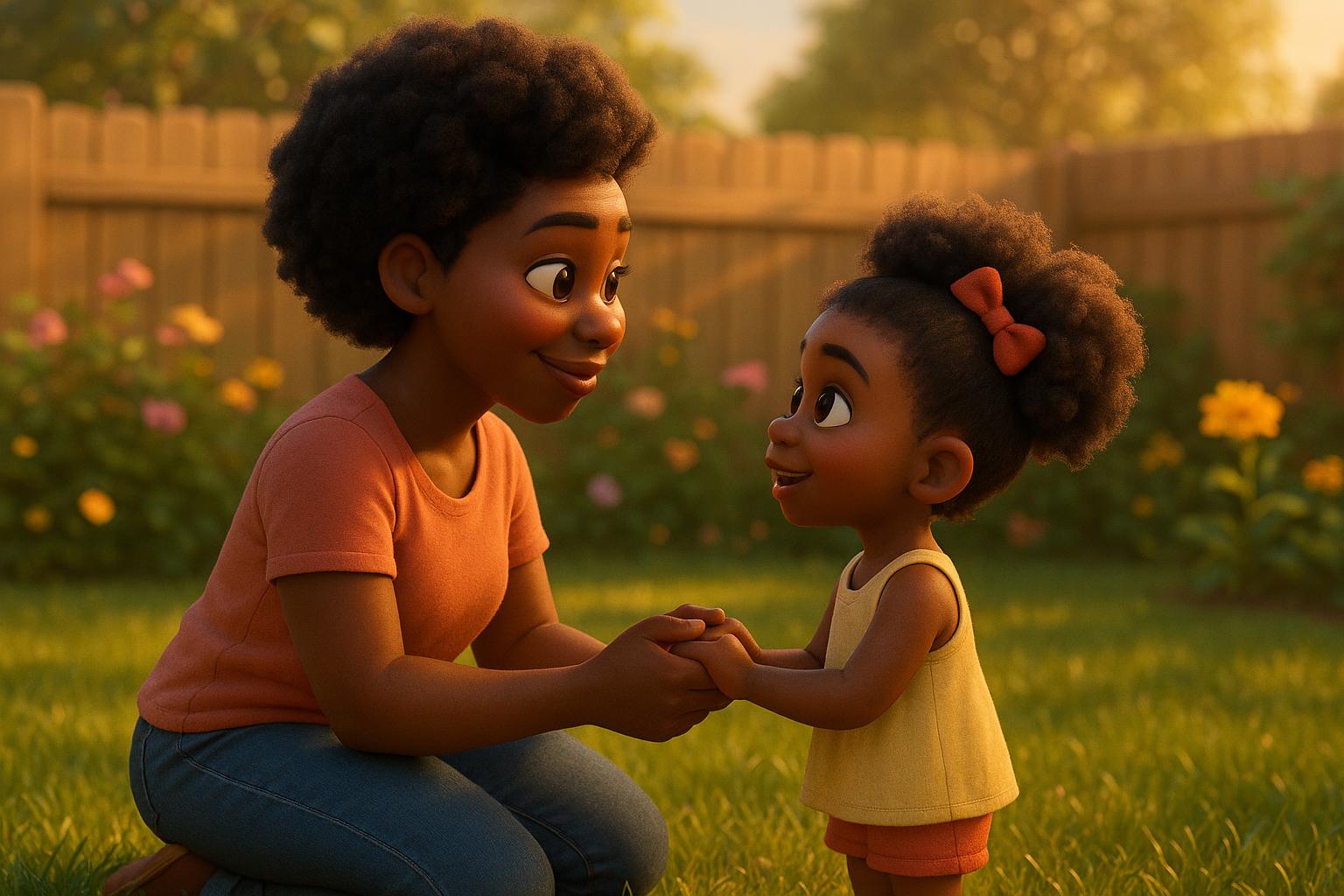
You protect the time. Real identity formation happens in presence. In moments when she has your full attention and knows she matters to you. This doesn't require money or elaborate experiences. It requires: looking her in the eye. Asking about her day. Reading together. Sitting with her in her feelings. Being present.
You do it while they still believe you. This isn't forever. In a few years, peer culture will matter more. She'll care what her friends think. She'll be influenced by media and algorithm. But right now? Right now, your word still counts. Use it.
The Garden Metaphor
Think of it like a garden.
If you wait until summer to plant—until your child is 8 or 9, when peer culture and comparison are already taking root—you're planting flowers while weeds are already established. The weeds will choke out your flowers. You'll spend all your energy pulling weeds instead of watching flowers grow.
But if you plant in spring—right now, while the soil is fresh—the flowers have a chance to establish roots before the weeds arrive. The foundation is strong. When the weeds come (and they will come), there's already something substantial to stand against it.
You can't prevent the weeds. You can't keep her from ever hearing a limiting message or experiencing rejection or feeling like she's not enough. The world is loud and it will get louder.
But you can plant the truth first. You can establish the foundation so deeply that when the world tries to redefine her, there's already something solid to push back against.
What This Sounds Like in Your Home
At breakfast: "You know what I noticed? You were patient with your sister this morning. You didn't yell at her even though she was annoying you. That's something good about you—you're someone who can be patient."
In the car: "I'm so glad you're my kid. Just because you exist. Not because of anything you did. Just because you're you."
At the grocery store: "I see you thinking about what to pick. You have good ideas. I trust your thoughts."
At bedtime: "You know what? You did your best today. Some things worked out, some things didn't. But you tried. And you were kind. That's enough. That's who you are."
After a mistake: "You messed up. That's okay. Everyone messes up. What matters is that you're going to figure out something different next time. I believe in you."
This isn't manipulation or false affirmation. It's not pretending she's perfect. It's pointing her to what's actually true about her and reinforcing it until it becomes part of her internal narrative.
What You're Competing Against
Let's be honest about what you're competing against:
Likes and Follows: The algorithm is teaching her that her worth is measurable and quantifiable. Even before she has social media, she's absorbing this from watching the people around her. You're saying "You matter because you're you." The world is saying "You matter if you're interesting enough."
Performance Culture: School is teaching her that love and approval are earned through achievement. You're saying "I love you because you exist." School is saying "I'm proud of you because you got an A."
Comparison: Peer culture is teaching her to measure herself against others. You're saying "You get to be you." The world is saying "You need to be like them."
Perfection: Media is teaching her to strive for an impossible standard. You're saying "You're enough." The world is saying "You need to fix yourself."
Speed: Culture is obsessed with development milestones and acceleration. You're saying "You get to be a kid." The world is saying "You're behind."
You're not going to win by being louder than the world. You can't out-shout the algorithm. But you can plant something deep enough that it doesn't get uprooted by the noise.
A Word for Parents Who Feel Behind
Maybe you're reading this and your child is already 7 or 8. Maybe you feel like you've missed the window. Maybe you're wondering if it's too late.
There's a famous quote: "The best time to plant a tree was 20 years ago. The second best time is now."
It's not too late. The window doesn't slam shut at age 6. It just gets narrower. It requires more intentionality, more repetition, more presence. Peer culture will have more voice. But your voice still matters.
Start now. Tell her who she is. Install the identity that's true. Yes, there will be voices competing with you. But they'll be competing with something, rather than trying to grow something in empty soil.
Even planting late is better than not planting at all.
The Real Work: Presence Over Perfection
Here's what you don't need to do to make this work:
- You don't need a perfect plan.
- You don't need a curriculum.
- You don't need to sit down and deliver a speech about her identity.
- You don't need to be perfect at parenting.
- You don't need to never lose your patience.
- You don't need to affirmm her every single moment.
Here's what you do need:
Consistency. Not perfection. Just showing up again and again and telling her the truth about who she is.
Presence. Not entertainment or enrichment or perfect experiences. Just moments where she has your full attention and knows she matters to you.
Truth. Seeing her clearly and reflecting back what you actually see, not false affirmation.
Time. This takes time. It's not an efficiency. It's a practice. It happens over five hundred bedtimes, two hundred car rides, a thousand small moments where you point her toward her own goodness.
Consistency over performance. One imperfectly delivered "I love you" said a thousand times beats a perfectly crafted identity-installation once.
The Practical Practice
If you want to start right now—tonight—here's what to do:
Look at your child. Not to evaluate her. Not to fix her. Just to see her. Who is she? What do you notice about her? What's true about her that the world might miss?
Name it. Find one thing—just one—that's true about her and say it out loud. "You're someone who thinks about other people's feelings." "You're brave for trying new things." "You're loved."
Say it again tomorrow. And the day after. And the day after that.
Repeat. Different phrases, different contexts, but the same core truth: You are beloved.
That's not just parenting. That's theology. That's gospel. That's telling your child what God has already said about her: I delight in you. I see you. I made you on purpose. Nothing you do changes this.
The world will tell her something different. It will tell her she's not enough. It will tell her she needs to be someone else. It will try to redefine her.
But if you've already installed the truth? If you've already planted the garden? Then she'll have something to stand on when those lies come.
Tell her who she is before the world tells her who she's not. While she still believes you. While the soil is still soft. While the window is still open.
The race is happening. You're already in it. The question is: what truth are you going to plant first?