


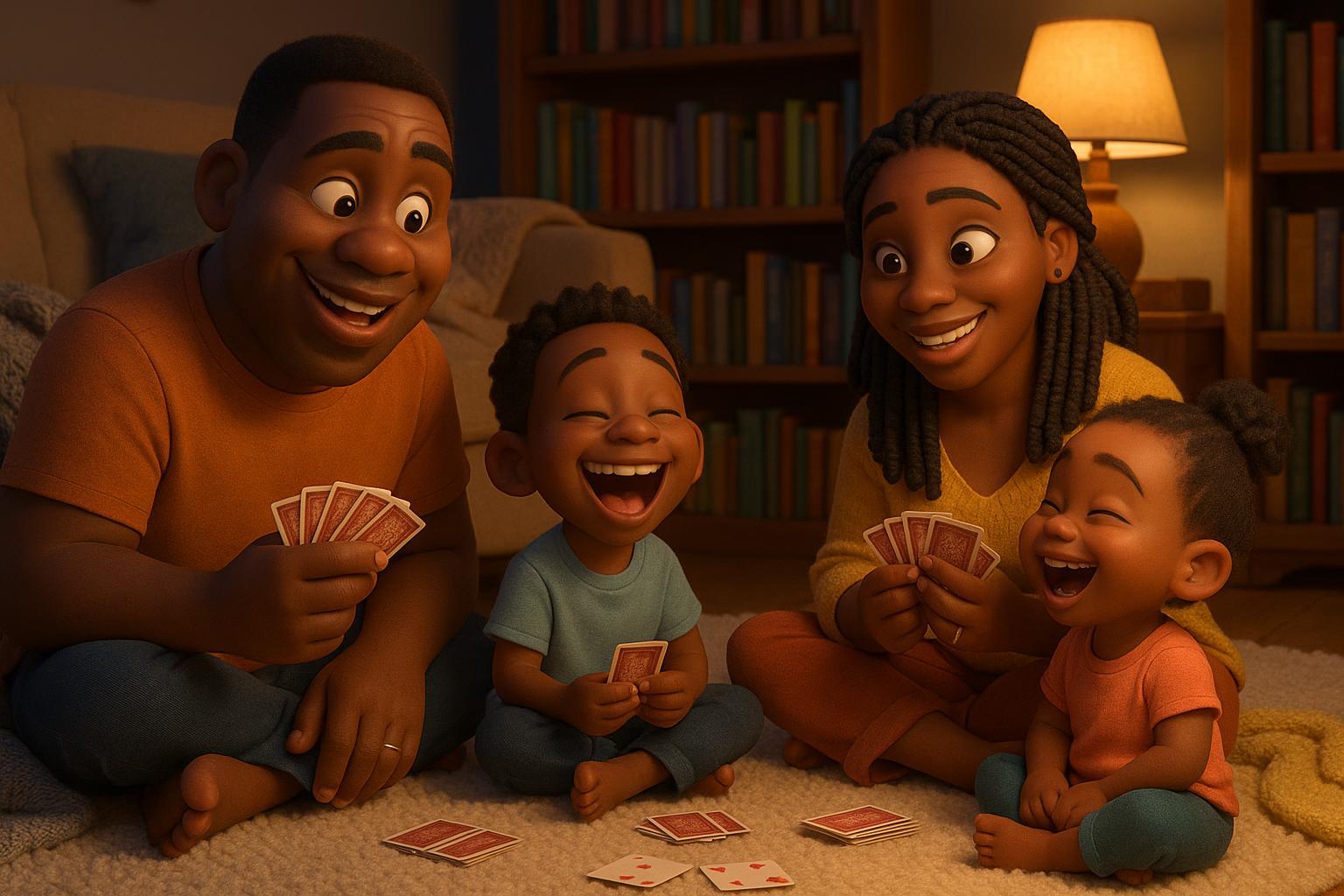
She's four years old and she's already learned to perform.
You'll notice it in small moments. She does something slightly funny, and then she looks at you to see if you're laughing. She tries a dance move and performs it for an audience. She takes a photo of her breakfast (no, she doesn't take it—she watches you take it and then sees herself through the screen) and in that moment, there's a little version of her learning: My life is for consumption. I exist to be viewed.
She's never had a TikTok account. She's never scrolled Instagram. She's probably barely used a screen. But culture is so loud now that it reaches children through ambient exposure, through the behavior of adults around her, through the architecture of modern life itself.
And you cannot out-shout the noise.
So the question isn't: "How do I keep my child away from screens?" It's: "How do I build something so deep and strong inside her that the noise doesn't define her?"
Culture is Designed to Do This
Before we talk about solutions, let's understand what we're actually facing.
There are technology companies whose explicit business model is to understand your child's psychology and design systems to exploit it. That's not conspiracy thinking. That's their stated business model. They have engineers whose job is to figure out what keeps a child's attention, what activates her dopamine receptors, what makes her want to come back.
The average child sees 4,000 to 10,000 advertisements per day. Not just traditional ads—sponsored content, product placements, influencer endorsements. The boundary between entertainment and advertising has dissolved.
Social media platforms use algorithms designed to show a child more of whatever keeps her engaged the longest. If she watches videos of girls who look a certain way, she'll see more of that. If she watches content about anxiety, she'll see more of that. The algorithm doesn't care about her wellbeing. It cares about engagement.
Your child is not born with comparison. That's learned. But comparison is profitable. A child who is insecure about her appearance will click more ads. A child who feels like she doesn't fit in will scroll more. An anxious child will return to the platform more often.
So this is the environment: an entire system designed by very smart people to shape how your child sees herself, what she wants, and how insecure she feels.
You cannot build a wall high enough. You cannot say no to screens and have her not still absorb these messages through culture. You cannot raise her in a bubble.
But you can do something else. You can build something so deep and true inside her that the noise becomes just noise.
The Operating System Metaphor
Think of identity like a computer operating system.
The apps are all the voices competing for her: social media, advertising, peer culture, school, whatever comes next. Apps are loud and flashy and designed to grab attention.
The operating system is the fundamental belief system underneath: Who am I? What do I believe about myself? What's my core value?
Here's what's happening in modern childhood: Kids are installing apps (absorbing cultural messages) without an operating system. So when an app crashes—when she gets a mean comment on TikTok, when she feels excluded by peers, when she sees an image of what she "should" look like—the whole system crashes.
There's nothing underneath to hold it up.
But if you install a strong operating system first? If she has a foundational belief in her own worth, her own lovability, her own belovedness? Then the apps can crash and the operating system still runs.
She'll still be influenced by culture. She'll still care what peers think. She'll still use screens and scroll and feel the pull of comparison. But it won't define her. She won't lose herself in it because there's a self to lose.
That operating system has to be installed before the apps take over.
The Window
Here's the thing about the operating system: it gets harder to upgrade as you get older.
A four-year-old still believes what her parents tell her about herself. A six-year-old mostly does. An eight-year-old is starting to check that against peer feedback. A ten-year-old is starting to be more influenced by what friends think than what parents think. By twelve or thirteen, the operating system is mostly installed.
If the primary message from her parents in years 3-8 was "You are loved, you are wanted, you belong," she has a solid OS. Apps will crash. She'll have insecure moments. But the foundation holds.
If the primary message was "Your worth is dependent on your performance," or "You need to earn love," or "What matters is looking good," then the OS is fragile. And when the apps hit—and they will hit—the system collapses.
Right now, you have a window where her beliefs about herself are still forming and still heavily influenced by you. This window gets smaller every year.
What You're Actually Installing
Let's be specific about what an "operating system" looks like in practical terms.
A secure child believes:
- I am loved unconditionally, not because of anything I've achieved
- I belong, even when I fail
- My thoughts and feelings matter
- My body is mine and I get to control it
- I can be myself and still be acceptable
- I'm allowed to have needs and ask for help
- Failure is information, not identity
- Other people's opinions don't define me
- I am safe to try things
An insecure child—shaped by cultural messages—often believes:
- I am loved for what I accomplish
- I belong only if I fit in
- What other people think matters more than what I think
- My body is something to be looked at and judged
- I need to be someone other than myself to be acceptable
- Having needs is a burden
- Failure means I'm not good enough
- Other people's opinions feel like facts about me
- Trying things is dangerous because I might fail
Notice the difference isn't about knowledge or skill or intelligence. It's about fundamental safety and worth. About whether a child believes she's okay as she is.
You're not installing that through rules or lessons. You're installing it through presence and repetition.
How Presence Defeats Noise
The most powerful antidote to cultural noise isn't more noise in the opposite direction. It's depth.
Technology companies have figured out how to make shallow engagement addictive: short videos, constant novelty, infinite scroll. The technology is frictionless. It's easy to come back. It requires no vulnerability, no depth, no presence.
What you're offering is the opposite. It's hard. It's vulnerable. It requires her to actually be herself with another person who sees her.
But it also does something screens can't do: it creates actual security.
When you put your phone down and really listen to your child, you're offering something that the algorithm can never offer. You're saying: You matter enough to have my full attention. Who you are, what you think, what you feel—it's important.
That's not a small thing. That's everything.
The neuroscience here is clear: children develop security through safe, attuned relationship. You can't replicate that with screens. You can't outsource it. And you can't skip it.
A child who gets ten minutes of real presence—eye contact, listening, attunement—develops more security than from hours of screen time.
So the practical answer isn't "Keep screens away." It's "Build depth first."
What This Actually Looks Like
You don't need a complicated plan. You need presence.
Car rides: No screens. Just you and her. Ask about her day. Tell her about yours. Listen while she talks.
Mealtimes: No screens. Just conversation. She talks about her feelings. You talk about yours. You model that thoughts and feelings matter.
Bedtime: This is the sacred time. No screens at least an hour before. Just her and you and maybe a story. This is where the operating system gets installed. This is where she feels: I am loved. I am safe. I belong.
Playtime: Sometimes play with her. Not to teach her anything or structure it perfectly. Just to be present while she creates and explores and imagines. Your presence alone tells her: You matter. What you're doing is worth my time.
Walks: Just walking together. Talking. Noticing things. Being outside. Not documenting it, not creating content—just experiencing it together.
These are not revolutionary things. They're the ordinary moments of parenting. But they've become countercultural because culture is so loud that ordinary presence feels radical.
What You're Protecting Against
Be specific about what you're actually worried about. Not because it will make you a fearful parent, but because specificity helps.
Identity fragmentation: A child who is performing constantly doesn't develop a stable sense of self. She becomes whoever is watching. She needs to know who she is separate from an audience.
Comparison: The constant exposure to curated versions of other people's lives teaches a child that her own life is not enough. She needs to believe her life is worth living before Instagram tells her it's not.
Anxiety: The constant threat of judgment, the infinite scroll, the fear of being left out—these are anxiety-inducing by design. She needs a baseline of security before the anxiety hits.
Commodification of self: A child who is taught to see herself as a product—to curate her image, to optimize her appearance, to perform her life—loses access to authenticity. She needs to know she's valuable as a person, not as a product.
Dopamine dysregulation: Screens are designed to hit dopamine receptors in a way that natural life isn't. A child who gets most of her stimulation from screens will find regular life boring. She needs real experiences that engage her mind.
Loss of boredom: This might sound strange, but boredom is where creativity happens. Boredom is where a child learns to entertain herself, to know herself, to discover what she actually likes. If she never experiences boredom, she never discovers herself.
For the Parent Who Feels Like It's Too Late
Maybe your child is already eight. Maybe she already has a device. Maybe she's already absorbing the messages. You're thinking: I missed the window. The apps are already installed.
Stop.
It's harder to upgrade an operating system than to install one initially. But it's not impossible. It's not too late.
Start now. Pull back from screens. Install presence. Tell her who she is. Have conversations. Listen to her. Let her be bored.
You won't undo what's already happened. But you'll be installing something underneath that can hold her up when the apps crash.
And they will crash. Every child in the current age has moments where the comparison, the judgment, the rejection feel like facts. But a child with secure parents can say: "That's a mean thought, but it's not true about me."
That's the operating system at work.
Jesus Was Counter-Cultural Too
If you're raising your child with Christian faith, there's something worth noting: Jesus modeled a completely different way of being in the world than what culture offered him.
He wasn't performing for approval. He wasn't comparing himself. He wasn't optimizing his image. He knew who he was—deeply and securely—and that knowledge made him free to love, to serve, to be present.
He was "in the world but not of it." That means he engaged the world. He didn't hide from it. But he wasn't shaped by it because his identity wasn't rooted in it.
That's what you're raising your child to do. Not to be naïve or unaware of culture. But to be so rooted in her own belovedness that culture can't define her.
The Antidote Isn't More Noise, It's More Depth
You can't out-shout TikTok. The algorithm has more resources than you do. The content is more polished, more stimulating, more addictive.
But you have something technology can never have: presence. Attunement. Real relationship. The power of looking at another person and saying, through your attention: You matter. You are seen.
That's not competing with screens on screens' territory. That's offering something completely different. Something deeper.
So the answer to "How do I raise secure kids in the age of TikTok?" isn't to fight the age. It's to build something so deep that the age can't touch it.
Presence defeats noise. Depth defeats algorithms. Relationship defeats performance. Love defeats comparison.
Install the operating system first. While the window is open. While she still believes you. Once the foundation is solid, she can handle the apps. She can use screens without losing herself. She can navigate culture without being shaped by it.
This isn't about being a perfect parent. It's not about never letting her have a screen. It's about understanding that the loudest voice in her life right now gets to be yours.
And your voice says: You are loved. You are safe. You belong. Who you are is enough.
Speak that into the noise. Say it again tomorrow. And the day after. Install it so deeply that when TikTok comes trying to redefine her, there's already something substantial pushing back.
That's not perfection. That's love.