


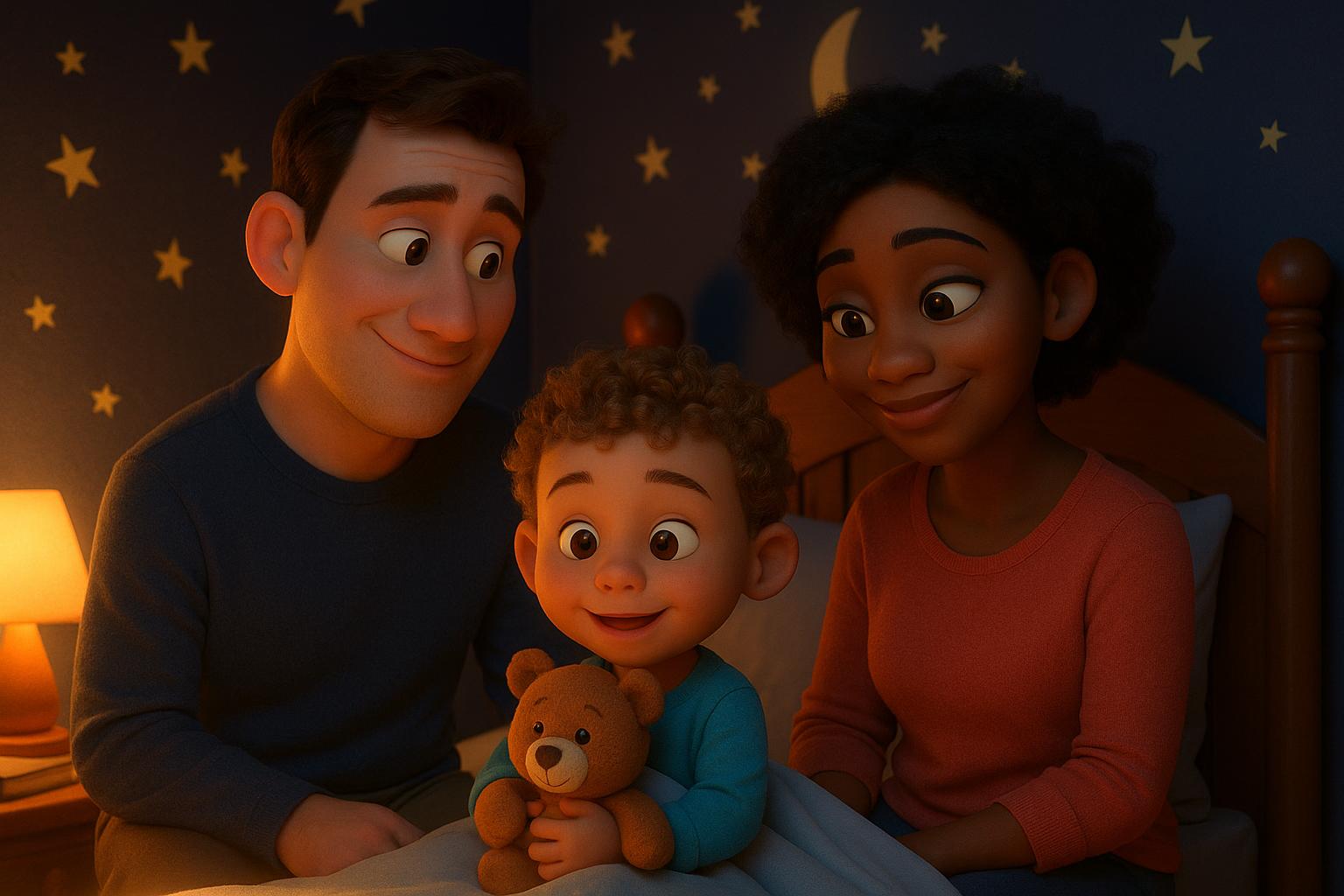
There's a moment most of us don't talk about. Your child is almost asleep, their breathing is slowing down, and you lean over and whisper something over them—maybe "You're so brave" or "I love you so much" or just a quiet goodnight. Their eyes are still open just barely. They hear you. And then they're gone into sleep.
That moment? It's holy ground.
I don't say that lightly. But something shifts in those sixty seconds before a child falls asleep. Their defenses are down. The day's noise is fading. Their brain is in a unique state that researchers call theta waves—that twilight space between wake and sleep where the conscious mind gets quieter and the subconscious becomes hungry for input.
And you're the voice they hear right before they disappear into dreams.
The Science of When You Say It
Most parents know they should tell their kids they're loved, capable, brave, enough. What most don't realize is that when you say it matters as much as what you say.
During the day, your child's brain is flooded with stimulation. School bells. Peer dynamics. Correction. Achievement markers. Their conscious mind is working overtime to navigate a thousand micro-decisions. When you tell them "You're so smart" at breakfast while they're thinking about whether Jamie will sit with them at lunch, some part of your message lands. But a bigger part is deflected by the noise.
But at bedtime—when their eyes are getting heavy and their nervous system is finally shifting toward rest—something different happens.
Neuroscientists have found that the brain doesn't shut down before sleep. Instead, it enters a state of increased receptivity. The prefrontal cortex (the part that analyzes, judges, compares) starts to dim. The limbic system (the part that feels and remembers) becomes more active. And theta waves—those slow, rhythmic brain patterns—increase.
In theta state, the subconscious isn't defending itself. It's listening.
This is why lullabies have worked across every culture for thousands of years. It's not the tune alone. It's that you're singing truth into a brain that's in a state to receive it without filtering it through the daily script of performance and achievement and earning love.
When you whisper "You are so loved, even when you make mistakes" to a child drifting toward sleep, you're not just giving information. You're creating neural pathways. You're speaking directly to the part of them that forms the foundation of who they believe they are.
Holy Ground
Moses took off his shoes because he was standing on holy ground. A burning bush. God present. The sacred breaking through.
But here's what I think most of us miss: your child's bedside is a burning bush too.
When you sit on the edge of their bed and speak identity over them, you are doing what the priesthood used to do. You're blessing them. You're declaring who they are. You're speaking the voice of God—unconditional delight, absolute belonging, fierce protection—into their life at the exact moment they're most open to receiving it.
This is ancient. This is sacred. This is not optional.
The theologians call it benediction—a pronouncement of blessing. The Old Testament is full of it. Fathers blessing sons before they died. Prophets speaking blessing over people. Even Jesus, right before a storm would test his disciples, spoke blessing over them. The rhythm is always the same: identity comes before challenge.
Your child will face wilderness moments. There will be friend drama. Academic pressure. the moment someone tells them they're not pretty enough, smart enough, athletic enough. There will be the day the world shows up with its measuring sticks and says "Prove yourself."
The question is: will they have a voice in their head by then? A voice that sounds like you, saying "I know who you are"?
That voice is built during bedtime. When their defenses are down and your words have a clear path to their soul.
The Ritual Matters More Than the Words
Here's the thing: bedtime doesn't have to be fancy or Pinterest-worthy. It doesn't need soft lighting or essential oils (though if that's your thing, go for it). The magic is not in the production. The magic is in the consistency.
Children's brains are built on repetition and rhythm. They need to know what's coming. It steadies them. And when a specific moment—like the last thing before sleep—gets marked by a specific truth being spoken, something settles in their system.
"Every single night, before I drift off, my mom says I'm brave." That's different from "My mom said I'm brave once." One becomes part of their inner voice. The other is just a nice memory.
You can start incredibly small. Pick ONE phrase. Just one. "You are so loved." Or "I'm so glad you're mine." Or "God loves you so much, and so do I." Then say it the exact same way, every single night, for the next month.
That's it. You're not trying to say everything that matters about your child in one bedtime speech. You're planting one seed so deep it becomes bedrock.
The Compound Effect
Researchers say it takes about 30 repetitions for something to become automatic. That's a month if you're reading every night.
By 30 nights: Your child's brain is starting to encode it. It's moving from short-term memory toward something more sticky.
By 100 nights: You might start seeing it reflected back in their language. "I'm brave," they'll say, not boastfully, but like they're stating a fact. Because you've said it enough times that it's starting to become their fact too.
By 365 nights: You've essentially rewired their operating system. When they face a challenge, the automatic thought that comes up isn't "I can't" or "I'm not enough." It's the voice you've been building for a year. "I'm brave. I'm loved. I belong."
This is not magic. This is neuroscience. This is also how the human soul actually works—through repetition, through ritual, through the steady voice of someone who loves you speaking the same truth until it becomes you.
Five Phrases You Can Start Tonight
If you're sitting there thinking "I don't even know what to say," here are five phrases you can pick from. Start with one. Pick your favorite. Say it tonight. And tomorrow night. And the night after that.
For the three-year-old:
- "You are so brave."
- "I love you so much."
- "You make me so happy."
For the five-year-old:
- "You are brave and kind."
- "God made you special, and I'm so glad He did."
- "You are loved, even when you make mistakes."
- "I love who you're becoming."
The non-negotiable version (works any age): "You are loved. Not because you were good today. Not because you listened. Just because you're you. And nothing will ever change that."
That last one is doing the heavy lifting of the entire Christian faith in one sentence. If you say that every night until your child is six, you will have fundamentally shaped how they experience God and how they see themselves. You will have given them armor.
If Your Bedtime Is a Nightmare Right Now
Maybe I just described a bedtime scene and you laughed out loud because your bedtime is chaos. Your kid won't sit still. There are tears. There's negotiation. Maybe you're skipping bedtime altogether and collapsing on the couch.
I get it. You're not failing. You're tired.
Here's the grace note: you don't need the Pinterest bedtime routine to plant identity. You don't need silence or calm or perfect conditions. You need one minute and one sentence.
Maybe it's whispered while they're still thrashing. Maybe it's said while they're getting their shoes on to go to grandma's. Maybe it's a text when you're apart. The format doesn't matter. The consistency does.
One phrase. Every single day. You don't have to be better at bedtime. You just have to be consistent at one sentence.
The Voice They'll Hear Forever
Here's what I want you to know: the voice your child hears right before they fall asleep doesn't just shape their night. It shapes their inner dialogue for life.
When they're sixteen and feeling friendless, they'll hear you: "You're kind."
When they're twenty-three and facing a career choice and they're scared, they'll hear you: "You're brave."
When they're thirty and they're struggling as a parent and they're questioning themselves, they'll hear you: "I love who you are."
These aren't just nice things we say to kids. These are the building blocks of identity. These are the voice of belonging that either does or doesn't form inside them. And the primary architect of that voice is you, in those sixty seconds before sleep.
The world will spend the rest of their life trying to tell them who they are. The comparison games. The achievement metrics. The social scripts about what makes you valuable.
But if you've spent their childhood saying the same true thing over and over in that sacred space right before sleep, you've already written it into their subconscious in a way that's very, very hard to erase.
Tell them who they are before the world does. Say it while they're falling asleep.
That's holy ground right there.