


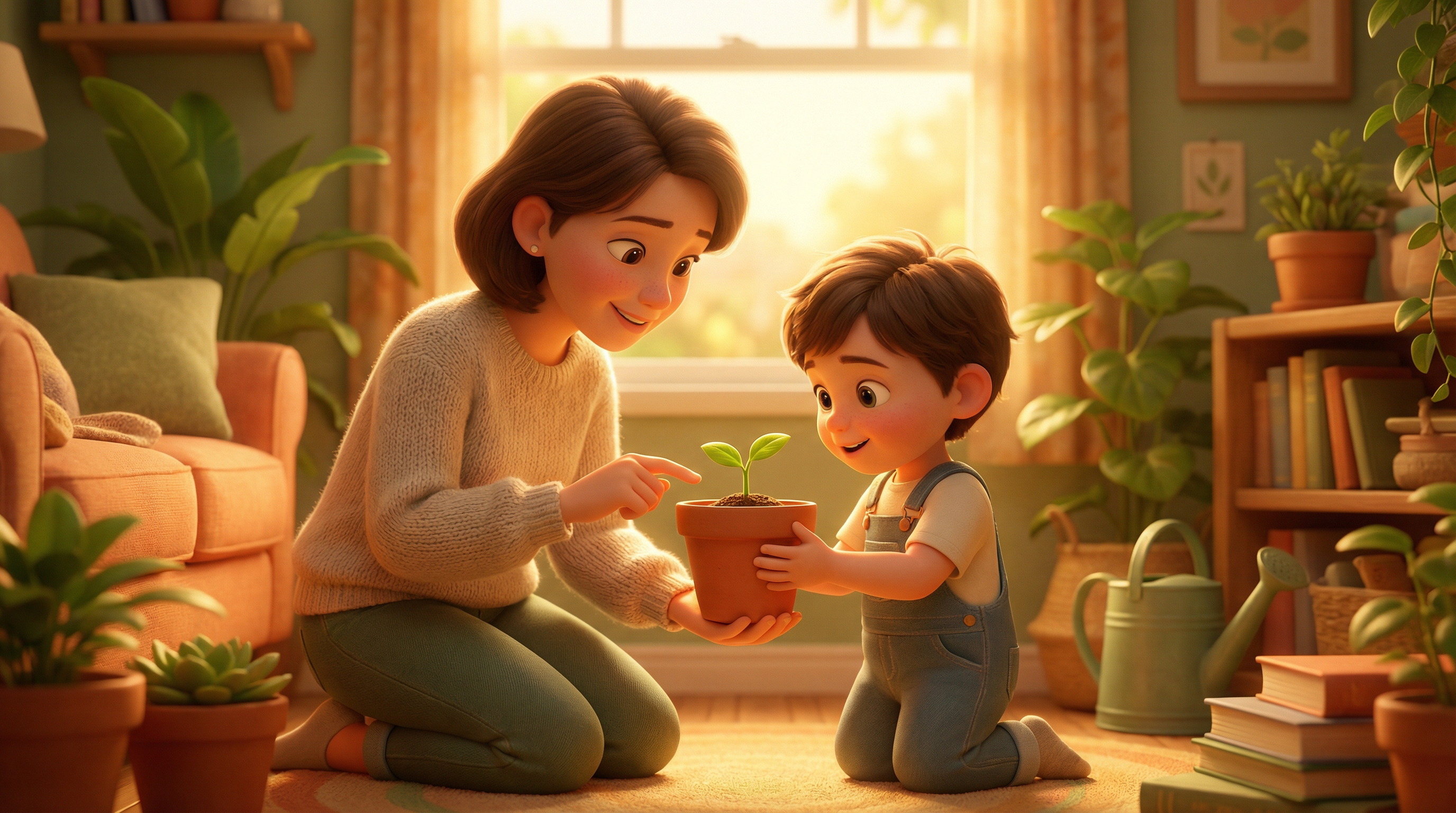
Plant an apple seed.
Water it. Give it sunlight. Tend to it for months. And you know what grows? An apple tree.
Not because you convinced it to become an apple tree. Not because you praised it for growing well or punished it for not growing fast enough. Not because you taught it some compelling lesson about what it means to be a tree.
It grows into an apple tree because that's what it is. That's its origin. That's its nature.
A child works the same way.
We spend so much energy focused on what our kids do—their achievements, their behavior, their performance in school, sports, social settings. We celebrate their wins. We work to correct their mistakes. We give them projects and goals and motivational speeches.
But we miss something fundamental: Who they are comes before what they do.
Your child isn't becoming a person through achievement. Your child is becoming a person through belonging. Through knowing where they come from. Through understanding their origin.
This is the Apple Seed Principle, and it changes everything.
The Origin Question
Every child, whether they know it or not, is asking one fundamental question: Where do I come from?
Not the biological question (though that matters too). But the deeper one: Who made me? Who chose me? Who am I connected to? Do I belong somewhere?
In the first six years of life—before they can think in abstract terms, before they understand conditional logic, before they develop a true "self" in the adult sense—your child is absorbing the answer to this question through relationship.
They're learning it from the tone of your voice. From whether you're delighted to see them when they wake up. From how you handle their anger, their mistakes, their confusion. From a thousand small moments where you communicate: You belong here. You come from good. You are wanted.
When this question is answered securely—Yes, I come from love. Yes, I am chosen. Yes, I belong—something remarkable happens. Your child develops a foundation. An internal knowing that doesn't depend on what they accomplish or who approves of them.
They become like the apple seed. Rooted in their nature.
The Neuroscience of Origin
Here's why this matters in the brain.
Your child's brain is 25% of its adult size at birth. Over the next five years, 90% of brain development happens. This window is critical. It's not the window where they learn to read or do math. Those come later. This is the window where they learn the fundamental question: Am I safe? Do I belong? Is there someone who will reliably be there for me?
Attachment researchers call this the "secure base." In human development, a secure base isn't a building or a checklist of accomplishments. It's a relationship. A person who is consistently present, responsive, and delighted.
When your child has a secure base, their brain develops differently. The amygdala—which processes fear and threat—doesn't overactivate. The prefrontal cortex—which handles rational thought and emotional regulation—develops more robustly. They're literally wired for confidence, curiosity, and resilience.
But here's the catch: The secure base isn't built on achievement. It's not built on the child being good or impressive or talented. It's built on something much simpler and much more powerful.
It's built on being seen and loved as they are.
Studies show that children who hear "I'm so proud of you" (after achievement) develop a fragile self-esteem. They become dependent on external validation. They're constantly monitoring: Am I doing well enough? Am I impressive? Am I earning approval?
But children who hear "I love watching you try" or "I love watching you be curious" or simply "I'm so glad you're you"—the unconditional stuff—develop something different. An internal anchor. A confidence that doesn't shake when they fail, because their worth was never on the line to begin with.
What Apple Seeds Look Like in Real Life
Let's get specific, because this is abstract stuff and parenting is concrete.
The Mirror Story.
Your two-year-old points at the mirror. "That's me!" They're delighted. They've discovered their own image. This is the beginning of self-awareness.
What you say next matters.
If you say: "That's you! Look how smart/beautiful/strong you are!" you're teaching them to see themselves through the lens of accomplishment.
If you say: "That's you! You're my [child's name]. You're part of our family. We made you. We love you," you're teaching them to see themselves through the lens of origin.
The first teaches: I am defined by my traits.
The second teaches: I am defined by my belonging.
One creates a child constantly measuring themselves. The other creates a child who is rooted.
The Name Story.
Your four-year-old asks: "Why is my name [name]?"
This is the origin question dressed up in another form. They're asking: Who chose me? What does my existence mean?
If you answer with a story—"We named you after my grandmother, who was so brave" or "Your dad suggested this name because it means joyful, and you were such a joyful baby" or "We chose this name because we love it and because God picked you for our family"—you're doing something profound.
You're telling your child: You were chosen. You were wanted. Your existence is connected to love and intention, not accident.
A child who knows their name story is a child who knows they come from somewhere. That they belong to something. That their arrival was celebrated.
The Tree Story.
Sit with your three-year-old on your lap. Tell them this: "Do you know what a seed is? It's so tiny. But inside that seed is everything it needs to become a big, strong tree. The tree doesn't have to work to be a tree. It just grows. And it grows because it's a tree."
Then: "You're like that seed. Inside you—even when you were just a tiny baby in Mommy's belly—you had everything you needed to grow. You're going to grow. You're going to be brave and kind and curious. Not because we're going to teach you to be those things, but because that's who you already are. That's your nature."
This is theology and science in the same breath. It's saying: You're not becoming a good person through effort. You're becoming yourself because of where you came from.
The Spoiling Question
Here's what every parent who hears this worries: "But won't my kid become spoiled? Won't they just do whatever they want?"
It's the most natural fear. Because we grew up in a system where love was tied to performance. So unconditional love sounds like permissiveness.
But that's not what research shows.
Children raised with secure attachment—with the knowledge that they belong unconditionally—actually show less destructive behavior. They have more self-control, not less. They're not constantly testing boundaries to see if they're still loved. They're not acting out to earn attention or prove their worth.
Instead, they're free to focus on growth. On learning. On becoming themselves.
The key is understanding that unconditional love and boundaries are not opposites. You can say: "I love you completely, AND we don't bite. I'm here for you no matter what, AND hitting isn't okay."
The child understands the difference. Their identity is secure (I am loved), so the boundary doesn't threaten them. They can hear it. They can internalize it. They can change their behavior.
But a child operating from insecurity—uncertain of their belonging—hears every boundary as a referendum on their worth. "You don't want me. You're disappointed in me. I'm bad."
That's the recipe for shame. For anxiety. For acting out.
Real confidence doesn't come from being able to do what you want. It comes from knowing you're wanted exactly as you are. From that secure base, a child can actually hear limits and grow.
The God Connection
Here's the beautiful part that ties this all together spiritually.
God tells you: "Before I formed you in the womb, I knew you" (Jeremiah 1:5).
Not: "When you learn to be good, I'll know you." Not: "When you accomplish things, I'll know you."
Before I formed you.
Your identity, in God's eyes, comes from your origin. You are known and loved not because of what you've achieved or what you can do. You are known and loved because God made you. Because you come from God.
This is what you're mirroring to your child.
When you look at your three-year-old and see them—really see them, with delight and wonder—and you tell them "You are God's. You are loved. You belong here," you're teaching them the gospel through your love.
You're saying: You come from good. Your existence is celebrated. Your worth is secure.
When your child learns this from you—the first love they ever knew—they develop a different relationship with themselves. And eventually with God.
They learn to see themselves the way God sees them: beloved, not for what they do, but for who they are.
What This Looks Like on Tuesday
Okay, theology and attachment science are great. But what about Tuesday morning?
Your five-year-old wakes up grumpy. He wants the blue cup, not the green one. He's upset about his hair. He complains about breakfast.
What if, instead of trying to fix his mood or correct his attitude, you just sat with him?
"Hey. I see you're having a rough morning. That's okay. You're still my favorite person. Would a hug help?"
No achievement. No performance. Just: You're having a hard time, and I'm still glad you're here. Your mood doesn't change how I feel about you.
Later that day, he brings home an artwork from school. It's a mess. He's frustrated. He crumpled it up.
Most of us default to: "Don't crumple it! It's beautiful! You did such a good job!"
But what if you said: "I can see you're upset with how it turned out. That's hard. You know what I love? I love that you tried. I love that you're creative. The painting doesn't have to be perfect for you to be amazing."
No false praise. No tying his worth to the quality of the art. Just: Effort matters. You matter. The outcome doesn't change how good you are.
These small moments are installing the Apple Seed Principle. You're teaching your child: Your worth comes from where you come from, not what you produce.
The Beloved Child
There's a phrase that appears throughout Scripture about God's love: "beloved."
"You are my beloved." "Beloved, you are already whole." "Before anything, you are beloved."
It doesn't mean best-behaved. It doesn't mean most impressive. It means most wanted. Most delighted in. Most securely connected.
This is what your child needs to know. Not as a wish or a hope. But as the foundational truth about who they are.
You are beloved.
Before you achieve anything. Before you try. Before you're good at something. You are beloved because you come from love, and you belong to love.
This is the Apple Seed Principle in its fullest form.
Plant that seed—the seed of knowing they're loved—in the first six years. Water it with presence. Give it light through your delight. Tend to it with your consistency.
And what grows won't depend on the soil conditions. It won't depend on the weather or the season. It will grow because that's its nature.
Your child will become not a high-achiever dependent on external validation. Not a perfectionist anxious about approval.
They'll become themselves. Rooted. Secure. Free.
An apple tree, growing exactly as it was designed to grow, because it came from an apple seed.
This Week
One moment this week, when your child does something ordinary—wakes up, asks for breakfast, shows you something they made—tell them:
"I'm so glad you're you. Not because of anything you did. Just because you exist. You're my favorite person."
Watch their face. See what happens when they hear, clearly and simply: I belong here. I'm wanted. My existence is celebrated.
That's the Apple Seed Principle. That's the foundation everything else grows from.
And it only takes one moment. One voice. One person who believes it first.
AlreadyLoved exists for these moments. To be the voice on hard mornings. To whisper what you might forget to say. To remind your child—night after night, in the safe darkness before sleep—that they come from love, they belong to love, and they are already, completely, loved.
You don't need anything special to do this. But if you want a tool that makes it easier, we're here.